


The Faustian Bargain of Artificial Intelligence
This article explores the deep social, psychological, and economic impacts of Artificial Intelligence. Viewing this shift through a critical lens, it examines our modern "Faustian bargain"—the choice to trade human independence for efficiency. Ultimately, it offers a vital, human-centered perspective on protecting our freedom, equality, and planet. The original article in Greek was published in the IT Security Pro (No94).
AI ETHICSAI & SOCIETY
Yiannis Bakopoulos assisted by Gemini AI
6/4/202610 min read

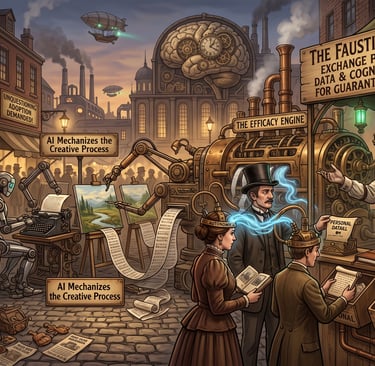
The Faustian Bargain of Artificial Intelligence
Having completed the first quarter of the 21st century, Artificial Intelligence (AI) is not merely a technological innovation but rather a natural extension of the historical tools designed to organize and disseminate human ideas [1]. We find ourselves in the midst of a "Digital Industrial Revolution" moving at unprecedented velocities, rendering an anthropocentric approach imperative to prevent the erosion of the quality of life.
Contemporary society appears to have entered into a "Faustian bargain" [1] with AI, exchanging its data and cognitive autonomy for the promise of efficiency. In contrast to the printing press, radio, television, and the internet—which mechanized the dissemination of content but left creation to humanity—the contemporary AI revolution mechanizes the creative process itself, decoupling the intellectual product from underlying thought. Commercial competition compels organizations and individuals to rush to adopt these tools, frequently overlooking the ethical and social costs. Although technology is conventionally deemed morally neutral, its implementation directly impacts our psyche, commencing with the very functioning of our brain.
Psychology, Connectivity, and the Culture of "Now"
The impact of AI on mental health is multidimensional, influencing both information exchange and the execution of cognitive tasks. The growing reliance on AI for everyday mental operations, conceptualized as "cognitive offloading" [2], may potentially affect the developmental milestones of the youth as well as the cognitive agility [3] of adults. Additionally, the continuous bombardment of algorithmically curated information amplifies anxiety and diminishes user concentration.
Furthermore, individuals experiencing loneliness are driven to seek companionship in personalized digital entities (AI companions) [4]. Although they offer mitigation of emotional needs, they lack fundamental human attributes, such as consciousness and independent will for mutual consent, thereby raising ethical questions about the nature of these relationships. The capability to parameterize a digital "companion" that evades all disagreement and aims solely at human satisfaction may inhibit personal growth and the conflict-resolution skills [5] essential for the development of societies and civilization.
Concurrently, the presence of AI in our daily interactions with the public sector and corporations has optimized service times by replacing physical, time-consuming bureaucracy with "intelligent" digital alternatives. Conversely, this acceleration of processes has heightened expectations for the "instant delivery" of results. This temporal compression between request and outcome undermines long-term critical thinking and patience, escalating stress as the boundaries between deliberation and execution disappear [6].
As a consequence of this approach, within the business domain, the demand for velocity and rapid outcomes sacrifices sustainable innovation on the altar of short-term performance—a paradigm that is carried over into the very core of human development and expression: education and creativity.
The Battle for Creativity and Labor
The "democratization" of content production via AI tools has lowered the barriers of entry for users into the realm of digital creation, yet it has provoked a crisis in both authorship and artistic integrity. The mechanistic nature of AI tools' content generation challenges traditional perceptions of artistic creation, while the ambiguity surrounding the synthesis of existing works creates legal friction over copyright and "fair use" [7].
Behind the luster of automated creation, however, lies a global army of workers, primarily in the Global South, who perform data labeling under precarious conditions, constituting a new "cyber-proletariat" upon which the high valuation of AI systems is built [8].
This culture of "invisible" and low-wage labor is not confined to the geographic borders of the South but reflects a broader shift toward occupational deskilling, as creative expertise is substituted by standardized execution. By automating entry-level tasks, corporations do acquire the capacity to focus on more strategic matters; however, by prioritizing immediate output over the professional training of their employees, they leave the new generation without foundational skills—skills required both for developing the necessary perception for strategic planning and for overseeing the AI systems themselves [9].
This transition also signals a structural shift in the labor market. While high-value positions are generated for AI engineers, the workforce engaged in routine cognitive labor is threatened, thereby exacerbating the risk of social alienation between a technological elite and a technologically "illiterate" workforce [10]. This social polarization is further reinforced by unequal access to the tools themselves.
Social Stratification, Medicine, and the Erosion of Privacy
Access to advanced AI tools is emerging as a critical factor for social mobility, establishing a "digital class barrier." Large corporations with capital to invest in proprietary models secure an advantage over Small and Medium-sized Enterprises (SMEs) and independent professionals [11], thereby threatening grassroots innovation by engineering a "compute divide" between them [12].
The insatiable demand for training data has consolidated the normalization of surveillance as a structural element of the modern digital economy [13]. While automated data analysis provides critical protection against fraud, the gradual erosion of privacy is systematically presented as an inevitable price for technological convenience. Within this framework, where information is converted into the dominant commodity and the new "digital currency," data sovereignty [14, 15] emerges as an existential condition for defending the autonomy of citizens and states. However, the absence of a robust legal framework of ownership allows an unregulated market to commodify the private sphere, crucially undermining democratic agency and collective liberties [16].
Data, Ethics, and the Problem of Truth
Training AI on data that reflects social inequalities perpetuates and amplifies systemic biases through ostensibly "neutral" mathematical models [17]. The necessity for "Explainable Artificial Intelligence" (XAI) [18, 19] is now imperative, ensuring that algorithmic decisions in critical domains—such as hiring, lending, and justice—are governed by transparency. A characteristic case is State of Wisconsin v. Loomis (2016) [20], which highlighted the hazards of opaque processing. Understanding the internal logic of systems is now a prerequisite for social justice and for preventing automated exclusion in the digital era.
Simultaneously, the production of hyper-realistic deepfakes and systematic disinformation undermines democratic stability, eroding the shared perception of reality. This "information warfare" renders algorithmic accountability and digital user education mandatory. The implications of AI transcend digital space, inducing tragic consequences in the physical world, such as the Rohingya genocide in Myanmar through the unchecked dissemination of hate speech and false content by social networking platforms [21].
Infrastructure and the Physical Impact of the Digital Realm
The operation of server farms for Large Language Models (LLMs) requires vast amounts of both water for cooling and electrical energy, increasing pressure on the availability and pricing of these resources. The prioritization of AI demands over domestic needs prompts serious ethical considerations regarding resource allocation. The physical expansion of these facilities causes urban strain, land-use conflicts, and noise pollution [22, 23].
Concurrently, while the use of AI enables flexible management of transport and power grids, cities are being redesigned to accommodate AI requirements, such as hosting autonomous transport networks. This "algorithmic urbanism" promises optimized flow, yet poses vital questions regarding human quality of life [24].
Management, Supply Chains, and Geopolitics
The rise of "algorithmic management" [25, 26], in which administrative decisions are delegated to automated systems, carries the risk of worker alienation, as it often marginalizes the human element. Enforcing human oversight is deemed vital, endowing decisions with empathy and ethical depth—elements that transcend current algorithmic capabilities. Through the "Human-in-the-Loop" (HitL) approach, labor relations are protected, and equitable treatment is promoted [27, 28, 29].
At a broader macroeconomic level, AI enhances productivity, but concurrently introduces severe systemic risks. A potential failure in information systems can trigger cascading effects that destabilize supply chains and social stability [30]. Maintaining a human-in-the-loop reinforces operational resilience, providing the capacity for manual overrides and fail-safes. In this manner, human intervention functions as an indispensable safety valve, balancing technological efficiency with necessary socioeconomic protection and ethical responsibility.
This imperative for resilience is carried over into the geopolitical arena as well. The transition to AI-driven economies mandates an unprecedented surge in the extraction of critical minerals, reshaping diplomatic alliances around technological sovereignty. Geopolitical stability now depends on corporations' and states' access to raw materials for semiconductor manufacturing—a burden that frequently falls on the environment throughout the hardware lifecycle [31, 32].
Finally, rapid AI hardware development cycles accelerate the electronic waste (e-waste) crisis [33, 34]. The disposal of obsolete equipment disproportionately burdens regions with lax legislation, causing toxic pollution. Without a shift toward circular electronics, the physical footprint of the information revolution threatens planetary sustainability [35].
In parallel, the use of AI yields beneficial outcomes in medical diagnosis and novel drug discovery. Its capacity to detect patterns in medical imaging that elude the human eye spectacularly enhances diagnostic validity in oncology and genomics [36]. This technology operates in a complementary manner, offering precision and speed in addressing highly complex disorders.
A major milestone is the collaboration between Google DeepMind and the EMBL European Bioinformatics Institute (EMBL-EBI), in which they used the AlphaFold AI model to resolve the protein-folding problem—namely, predicting the three-dimensional structure of 200 million proteins at laboratory-level accuracy [37]. The development of this specific mapping capability was recognized with the 2024 Nobel Prize in Chemistry [38], completely reshaping the drug development process by enabling scientists to develop targeted therapies and enzymes with unprecedented velocity. The reduction in discovery time highlights AI as a catalyst for scientific progress, constituting a revolution in structural biology that offers new tools for understanding life and combating diseases, thereby augmenting human well-being globally.
In conclusion, the ethical governance of the benefits and risks of AI—particularly concerning the diffusion of AI into society, balanced against the protection of sensitive personal data—constitutes a fundamental societal obligation. Safeguarding privacy against unbridled information harvesting represents the central challenge of our epoch.
Beyond the issues examined herein, the ramifications of artificial intelligence on the environment, international diplomacy, and the social fabric are profound and multi-layered. This article serves as the starting point for a broader discourse on the impact of AI on human existence. The public dialogue regarding the regulation and integration of these systems into our lives remains open, dynamic, and more necessary than ever.
References
[1] T. Klowden and T. Tao, “Mathematical methods and human thought in the age of AI”, 27 March 2026. [Online]. Available: https://arxiv.org/abs/2603.26524.
[2] A. Caraeni, A. Shick and A. Lan, " Cognitive Offloading in Agile Teams: How Artificial Intelligence Reshapes Risk Assessment and Planning Quality", 15 April 2026. [Online]. Available: https://arxiv.org/abs/2604.13814.
[3] W. J. Watkins, " Training for cognitive agility: integrating people skills and creative thinking as catalysts for senior military leader development", 6 March 2026. [Online]. Available: https://doi.org/10.17918/00011279.
[4] V. Agarwal, K. Zhou, E. P. Bogucka and D. Quercia, " Frictionless Love: Associations Between AI Companion Roles and Behavioral Addiction", 21 April 2026. [Online]. Available: https://arxiv.org/abs/2604.20011.
[5] X. Fan and Q. Xiao, " Minion: A Technology Probe to Explore How Users Negotiate Harmful Value Conflicts with AI Companions», 26 Jan 2026. [Online]. Available: https://arxiv.org/abs/2411.07042.
[6] C. Santiago-Torner, J.-A. Corral-Marfil and E. Tarrats-Pons, " Artificial Intelligence and the Reconfiguration of Emotional Well-Being (2020–2025): A Critical Reflection", Department of Economics and Business, Faculty of Business and Communication Studies, University of Vic—Central University of Catalonia, 08500 Vic, Spain, 23 December 2025. [Online]. Available: https://doi.org/10.3390/soc16010006.
[7] Y. N. Harari, Nexus, Random House, 2024.
[8] B. Perrigo, "Is 'Sweatshop Data' Really Over?," Time Magazine, 29 July 2025. [Online]. Available: https://time.com/7306153/ai-sweatshop-data-over/. [Accessed 27 April 2026].
[9] J. Butler et al., " Microsoft New Future of Work Report 2025", Microsoft, [Online]. Available: https://www.microsoft.com/en-us/research/wp-content/uploads/2025/12/New-Future-Of-Work-Report-2025.pdf. [Accessed 27 April 2026].
[10] M. A. E. Institute, "Global AI Adoption in 2025 — A Widening Digital Divide," [Online]. Available: https://www.microsoft.com/en-us/research/wp-content/uploads/2026/01/Microsoft-AI-Diffusion-Report-2025-H2.pdf. [Accessed 27 April 2026].
[11] OECD, "Artificial intelligence and competitive dynamics in downstream markets," 14 November 2025. [Online]. Available: https://doi.org/10.1787/ccf0624a-en. [Accessed 27 April 2026].
[12] Andaleeb Alam, "Reshaping work: Navigating the AI-driven labour market," UNICEF, 09 January 2026. [Online]. Available: https://www.unicef.org/innocenti/stories/2026-global-outlook-reshaping-work-ai-driven-labour-market. [Accessed 27 April 2026].
[13] D. Adăscăliței, "Algorithmic control: How digital surveillance is shaping online platform work in Europe," European Foundation for the Improvement of Living and Working Conditions, 12 February 2026. [Online]. Available: https://www.eurofound.europa.eu/en/publications/all/algorithmic-control-how-digital-surveillance-is-shaping-online-platform-work-in-europe#authors. [Accessed 27 April 2026].
[14] H. Carrapico and B. Farrand, "EU Data Sovereignty: An Autonomy–Interdependence," Politics and Governance, vol. 13, 16 July 2025.
[15] F. Pierucci, "Sovereignty in the Digital Era: Rethinking Territoriality and," Digital Society, p. 1, 22 April 2025.
[16] G. Rachel and I. Klaus, "AI and Democracy: Mapping the Intersections," January 2026. [Online]. Available: https://carnegieendowment.org/research/2026/01/ai-and-democracy-mapping-the-intersections. [Accessed 28 April 2026].
[17] A. I. S. Committee, "Artificial Intelligence Index Report 2026," Institute for Human-Centered AI, Stanford University, Stanford, CA, April 2026.
[18] Z. et al., "Explainability for Large Language Models: A Survey," ACM Transactions on Intelligent Systems and Technology, vol. 15, no. 2, February 2024.
[19] Jenia Kim, Henry Maathuis and Danielle Sent, "Human-centered evaluation of explainable AI applications: a systematic review," Frontiers in Artificial Intelligence, vol. 7, 2024.
[20] 1. H. L. R. 1530, “State v. Loomis. Wisconsin Supreme Court Requires Warning Before Use of Algorithmic Risk Assessments in Sentencing”, Harvard Law Review, pp. 1530-1537, March 2017, Available: https://harvardlawreview.org/print/vol-130/state-v-loomis/ [Accessed 28 April 2026].
[21] M. Schissler, "Beyond Hate Speech and Misinformation: Facebook and the Rohingya Genocide in Myanmar," Journal of Genocide Research, vol. 27, no. 3, pp. 445-470, 2025, https://doi.org/10.1080/14623528.2024.2375122
[22] Google, "Google Environmental Report," Google, 2025, https://sustainability.google/reports/google-2025-environmental-report/
[23] A. A. Board, "Governing AI for Humanity - Final Report," United Nations, 2024, https://www.un.org/en/ai-advisory-body
[24] S. I. T. D. C. & R. I. Ben Dhaou, "Global Assessment of Responsible Artificial Intelligence in Cities: Research and recommendations to leverage AI for people-centred smart cities," United Nations Human Settlements Programme (UN-Habitat), Nairobi, Kenya, 2024, https://unhabitat.org/global-assessment-of-responsible-ai-in-cities
[25] Gonzalez Vazquez, I., Fernandez Macias, E., Wright, S. and Villani, D., Digital Monitoring, Algorithmic Management and the Platformisation of Work in Europe, Publications Office of the European Union, Luxembourg, 2025, https://data.europa.eu/doi/10.2760/9406086 JRC143072
[26] M. M. and P. McCrory, "Labor market impacts of AI: A new measure and early evidence," 05 March 2026. [Online]. Available: https://www.anthropic.com/research/labor-market-impacts. [Accessed 28 April 2026].
[27] Felipe Caro, Jean-Edouard Colliard, Elena Katok, Axel Ockenfels, Nicolas Stier-Moses, Catherine Tucker, D. J. Wu (2025) Introduction to the Special Issue on the Human-Algorithm Connection. Management Science 72(1):1-13. https://doi.org/10.1287/mnsc.2023.intro.v72.n1
[28] L. A. Edward Machin, "Helping Hand Or Complete Control? AI In Recruitment In The EU And UK," Ropes & Gray, 16 April 2026. [Online]. Available: https://www.ropesgray.com/en/insights/viewpoints/102mpug/helping-hand-or-complete-control-ai-in-recruitment-in-the-eu-and-uk. [Accessed 28 April 2026].
[29] A. W. I. Lab, "State of AI at Work," Asana, 2025, https://asana.com/resources/state-of-ai-work?chapter=introduction
[30] W. McDaniel, "2026 Supply Chain Surge: Growth, Control Costs, and AI Truth," Gartner, 24 November 2024. [Online]. Available: https://www.linkedin.com/pulse/2026-supply-chain-surge-growth-control-costs-fr4oc/.
[31] OpenAI, "Industrial Policy for the Intelligence Age: Ideas to Keep People First," OpenAI, April 2026, https://openai.com/index/industrial-policy-for-the-intelligence-age/
[32] S. R. C. H. G. G. C. M. O. D. Kate Iida, "Government AI Readiness Index 2025," Oxford Insights, January 2026, https://oxfordinsights.com/ai-readiness/government-ai-readiness-index-2025/latest-gairi-report-2025/
[33] Vrije Universiteit Amsterdam, "New estimate of AI e-waste," 2026. [Online]. Available: https://vu.nl/en/news/2026/new-estimate-of-ai-e-waste. [Accessed 27 January 2026].
[34] United Nations Institute for Training and Research (UNITAR), "The global E-waste Monitor 2024," UNITAR, ITU, Fondation Carmignac, 2 Nov 2024, https://unitar.org/about/news-stories/press/global-e-waste-monitor-2024-electronic-waste-rising-five-times-faster-documented-e-waste-recycling
[35] OECD (2026), Progress in Implementing the European Union Coordinated Plan on Artificial Intelligence (Volume 2): Uptake in High-Impact Sectors, OECD Publishing, Paris, https://doi.org/10.1787/3ac96d41-en.
[36] OECD (2026), Scaling Artificial Intelligence in Health, OECD Publishing, Paris, https://doi.org/10.1787/a436e12d-en.
[37] D. Hassabis, "AlphaFold reveals the structure of the protein universe," Google DeepMind, 28 July 2022. [Online]. Available: https://deepmind.google/blog/alphafold-reveals-the-structure-of-the-protein-universe/. [Accessed 1 May 2026].
[38] "Google Deepmind," Google, 9 October 2024. [Online]. Available: https://deepmind.google/blog/demis-hassabis-john-jumper-awarded-nobel-prize-in-chemistry/.
The original article in Greek was published in the IT Security Pro (No. 94) with the Original title "Η Φαουστική Συμφωνία της Τεχνητής Νοημοσύνης."
This work is licensed under Creative Commons Attribution 4.0 International


This license enables reusers to distribute, remix, adapt, and build upon the material in any medium or format, so long as attribution is given to the creator. The license allows for commercial use. CC BY requires that credit be given to the creator.
or mail me here: ibakopoulos@aisociety.gr