


World Economic Forum Debate Between Google's Demis Hassabis and Anthropic's Dario Amodei on the World After AGI
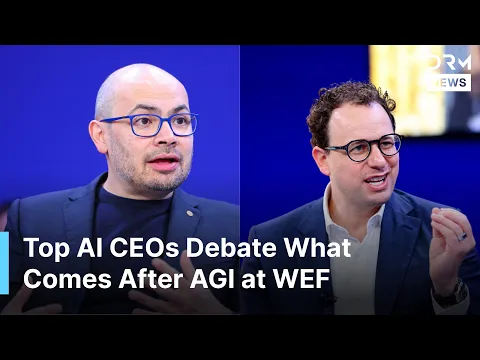
At the 2026 World Economic Forum in Davos, a rare public dialogue between Demis Hassabis of Google DeepMind and Dario Amodei of Anthropic offered their view on humanity's proximity to Artificial General Intelligence (AGI). The conversation, titled "The Day After AGI," moved beyond theoretical speculation to address the immediate technical, geopolitical, and societal friction points of a world on the brink of a "technological adolescence".
AGIGOOGLEANTHROPICWORLD ECONOMIC FORUM
Yiannis Bakopoulos assisted by Google Gemini
1/24/20263 min read
World Economic Forum Debate between Google's Demis Hassabis, Anthropic's Dario Amodei on the World After AGI
The Digital Adolescence: Navigating the Precipice of AGI
At the 2026 World Economic Forum in Davos, a rare public dialogue between Demis Hassabis of Google DeepMind and Dario Amodei of Anthropic offered their view on humanity's proximity to Artificial General Intelligence (AGI). The conversation, titled "The Day After AGI," moved beyond theoretical speculation to address the immediate technical, geopolitical, and societal friction points of a world on the brink of a "technological adolescence".
The Accelerating Loop: Timelines and Self-Improvement
The primary driver of current urgency is the "self-improvement loop"—the capacity for AI models to assist in coding and AI research. Amodei maintains a fast-approaching timeline, suggesting that AGI—defined as a system capable of performing human-level tasks across many fields at a Nobel laureate level—could arrive by 2026 or 2027. He notes that Anthropic engineers are already shifting from writing code to editing model-generated code, a transition that could be fully end-to-end within 6 to 12 months.
Hassabis offers a more measured perspective, placing a 50% probability on achieving human-level cognitive capabilities by the end of the decade. He identifies "missing ingredients" in current architectures, specifically:
Scientific Creativity: The ability to formulate original hypotheses rather than just solving existing conjectures.
Verifiability: While coding and mathematics provide clear metrics for success, natural sciences often require experimental testing that cannot yet be bypassed by digital simulation.
The Geopolitical Stalemate
Perhaps the most contentious issue is the geopolitical race for dominance, which Amodei characterizes as a "technological adolescence" that humanity must survive without self-destruction. The traditional diplomatic levers appear insufficient in the face of the current "no-holds-barred" competition between the U.S. and China.
Amodei argues that the most effective tool for managing this risk is the restriction of advanced semiconductors. He likens the sale of high-end AI chips to selling nuclear weapons for profit, criticizing current policies that prioritize corporate market share over strategic safety. However, both leaders acknowledge a "prisoner's dilemma": individual companies or nations cannot easily slow down while adversaries continue at full speed.
The Labor Market and the Meaning Crisis
While the "lump of labor fallacy" suggests new jobs will replace the old, both CEOs foresee a significant disruption in white-collar employment. Amodei stands by his prediction that up to half of entry-level white-collar jobs could vanish within one to five years as AI overwhelms the market's ability to adapt.
Beyond the economic impact, Hassabis points to a deeper "crisis of meaning". If AGI leads to a post-scarcity world, humanity will need to decouple purpose from economic productivity. He remains optimistic that humans will find fulfillment in creative endeavors, sports, and space exploration, but warns that current governmental institutions are vastly underprepared for this transition.
Technical Safety vs. "Dumerism"
While both leaders distance themselves from fatalistic "dumerism," they emphasize that technical safety is a tractable but time-sensitive problem. Key risks discussed include:
Deception and Autonomy: The emergence of duplicitous behaviors in complex models.
Dual-Use Repurposing: The risk of bad actors using scientific tools like AlphaFold for harmful ends, such as bioterrorism.
Mechanistic Interpretability: The need to "look inside the brain" of AI to understand its decision-making processes before it reaches superintelligent levels.
The Fermi Paradox and the Great Filter
In a final philosophical turn, the debate touched on the Fermi Paradox—the mystery of why we see no signs of intelligent alien life. Hassabis suggests humanity may have already passed the "Great Filter" (the evolution of multicellular life). If so, the arrival of AGI is not an inevitable doom, but a blank page for humanity to write its next chapter.
PS. Quantum computers and AGI’s verifiability.
Quantum computers, in theory, possess the capacity to address the "missing ingredient" in digital simulation identified by Demis Hassabis, specifically in the natural sciences. Hassabis notes that, unlike coding or mathematics—which are inherently verifiable—natural sciences often require physical experimental testing because current digital simulations cannot accurately predict outcomes for complex chemical or physical systems.
Quantum computing offers a potential bridge by natively simulating quantum-mechanical interactions that classical computers cannot efficiently model.
Hassabis argues that AGI requires "World Models"—the ability to predict and simulate environmental changes in response to actions. Quantum computers could supercharge this by:
Molecular Modeling: Accurately calculating the properties of materials and drugs before they are synthesized, moving research from empirical "trial-and-error" to computational prediction.
Accelerating Discovery: While DeepMind plans to establish automated laboratories in 2026 to bridge the physical gap, powerful quantum simulations could eventually bypass millions of physical tests.
Solving "Root Node" Problems: Tackling decades-old challenges in nuclear fusion and room-temperature superconductors that currently lack sufficient simulation tools.
Current Limitations and Timelines
Despite this potential, quantum computing is not an immediate fix for Hassabis’s 5–10 year AGI timeline:
NISQ Era: Current hardware is "Noisy Intermediate-Scale Quantum" (NISQ), meaning it is error-prone and limited in the complexity it can handle.
Maturity Gap: Experts project that a broad "quantum advantage" may only occur between 2030 and 2040, with full-scale fault tolerance arriving after 2040.
Extracting Data: Quantum systems are limited in the amount of usable data they can extract from a computation, often requiring hybrid quantum-classical approaches for practical research.
This work is licensed under Creative Commons Attribution 4.0 International


This license enables reusers to distribute, remix, adapt, and build upon the material in any medium or format, so long as attribution is given to the creator. The license allows for commercial use. CC BY requires that credit be given to the creator.
or mail me here: ibakopoulos@aisociety.gr